Friday, October 6, 2017
Quick Link: Why had England lost its Medieval taste for violence.
An interesting article that trys to describe the changes in society and accepted behavior around violence and murder. Not strictly related to swords, I felt that it was an interesting companion the art of defense. Certainly there are legal and moral considerations that occasionally crop up in the manuals. For example, there are several manuals who implore the reader to not take the book and then seek violence amongst his family or neighbors. There are several who suggest applicable targets (the English really didn't like the French, or at times, the Italians and Germans).
Regardless, I thought this was worth the short read
Article is here.

Friday, April 28, 2017
Quick Link: Analysis and Comparison of two German thrust-fencing manuscripts.
The new Acta Periodica Duellatorum is out, and with it new and interesting articles. This one is an intersting comparison of two later German manuals that are based on Fabris' manual.
Link here.
Link here.
Friday, April 21, 2017
Babies and Explosiveness

What
would happen if a year-old baby fell from a fourth-floor window onto
the head of a burly truck driver, standing on the sidewalk?
It's
practically certain that the truckman would be knocked unconscious.
He might die of brain concussion or a broken neck.
Even
an innocent little baby can become a danger ous missile WHEN ITS
BODY-WEIGHT IS SET INTO FAST MOTION.
You
may feel as helpless as a year-old infant-as far as fighting is
concerned; but please remember: (1) YOU WEIGH MORE THAN A BABY, and
(2) YOU NEED NOT FALL FROM A WINDOW TO PUT YOUR BODY-WEIGHT INTO
MOTION.
You
have weight, and you have the means of launching that weight into
fast motion.
Furthermore,
you have explosive ingredients. You may not appear explosive. You may
appear as harmless as a stick of dynamite, which children have been
known to mistake for an oversized stick of taffy.
You
can launch your body-weight into fast motion; and, like dynamite, you
can explode that hurtling weight against an opponent with a stunning,
blasting effect known as follow-through.
From Championship Fighting by Jack Dempsey
Friday, April 7, 2017
The Thun Sketchbooks
The Thun Sketchbooks were preliminary drawings of commissioned armour. These drawings were then kept by armourers as records of their projects. There are only four of these highly detailed sketchbooks that are known, two which have long been available, and two which were last seen in 1936. Eventually these were tracked to a museum in the Czech republic, where they found to be in near perfect condition.
This paper reviews the types of armour found in the sketchbooks, and has gorgeous illustrations of armor from the Hapsbergs.
Link Here.
Friday, March 24, 2017
Stance Revisited
After a longer period of study, I realize that I had overlooked an important element of stance in my previous post- the torso.
Previously, I focused rather exclusively on foot and hip position, first with the upright fencers of late 1500s and then the open hipped, back weighted fencers of the 1600s. This emphasis is a bias on my part- I'm always trying to improve my footwork.
Over time I've come to realise that figuring out what to do with the top half of your body is equally important, especially since it will affect both your feet and your arm. There seems to be two main groups of rapier manuals (other than the Spanish). The first is the forward leaning Fabris, and the second is the back postured Giganti. See here for a more extensive review on the topic.
Having tried both for a bit, I've come to appreciate both for their own merits, although I am sure there are more nuances to the stances I haven't discovered yet.
At first, Fabris' forward leaning stance was a bit odd to me. Typically in sword fighting you don't want to lead with your head. However, what the stance does it puts your body behind your head, and your head behind both the rapier and head-sized quillons. This leads to an extremely limited area for your opponent to target, and what little target there is, is behind a sword. The placement of the hips and shoulders seems to lend itself to passing steps and cuts. His system also minimizes blade contact.
For Giganti, the most difficult part for me was lunging out of a back loaded stance. I'm still not extending as far as I should be, nor am I as fast. It does seem, however, that his lunges weren't as deep as others, since he states 'Still, this is a extremely versatile stance, and it allows for a great variety of distance changing, with comparatively little movement.' On the other hand the quote above advises to bend the knee as much as possible, which is typically what I try for in training. I figure that if you train to go deep, you can certainly make a narrower lunge.
The thing that stands out most while training both stances is the importance of athletic ability. Giganti says specifically that until you can do 100 madrittos and 100 roversos, your arm wasn't strong enough for fencing.
I'm still working on that one.
Previously, I focused rather exclusively on foot and hip position, first with the upright fencers of late 1500s and then the open hipped, back weighted fencers of the 1600s. This emphasis is a bias on my part- I'm always trying to improve my footwork.
Over time I've come to realise that figuring out what to do with the top half of your body is equally important, especially since it will affect both your feet and your arm. There seems to be two main groups of rapier manuals (other than the Spanish). The first is the forward leaning Fabris, and the second is the back postured Giganti. See here for a more extensive review on the topic.
Having tried both for a bit, I've come to appreciate both for their own merits, although I am sure there are more nuances to the stances I haven't discovered yet.
At first, Fabris' forward leaning stance was a bit odd to me. Typically in sword fighting you don't want to lead with your head. However, what the stance does it puts your body behind your head, and your head behind both the rapier and head-sized quillons. This leads to an extremely limited area for your opponent to target, and what little target there is, is behind a sword. The placement of the hips and shoulders seems to lend itself to passing steps and cuts. His system also minimizes blade contact.
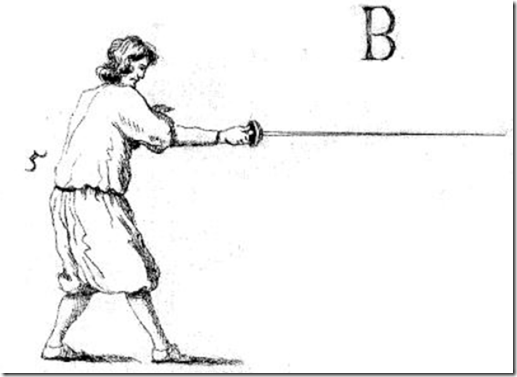
After discussing the guards, counter-guards, measures and tempi, I need to show and explain how to carry your body while delivering a thrust and recovering. While studying this art, you must first learn how to carry your body and deliver lunging thrusts that are as long as the one you see in this illustration. The heart of the matter is the ability to deliver quick, long, strong lunging thrusts and immediately recover out of measure.
To deliver a lunging thrust, set yourself in a solid stance, better if a bit narrower rather than wide so that you may then extend your front foot forward. While delivering the thrust, extend the sword-arm and
bend the knee as much as possible.
For Giganti, the most difficult part for me was lunging out of a back loaded stance. I'm still not extending as far as I should be, nor am I as fast. It does seem, however, that his lunges weren't as deep as others, since he states 'Still, this is a extremely versatile stance, and it allows for a great variety of distance changing, with comparatively little movement.' On the other hand the quote above advises to bend the knee as much as possible, which is typically what I try for in training. I figure that if you train to go deep, you can certainly make a narrower lunge.
The thing that stands out most while training both stances is the importance of athletic ability. Giganti says specifically that until you can do 100 madrittos and 100 roversos, your arm wasn't strong enough for fencing.
I'm still working on that one.
Friday, March 17, 2017
Giovanni Dall’Agocchie - Solo Form
In the conclusion of his discussion of the guards, Giovanni Dall’Agocchie includes a short solo form to 'step into the guards.' While at first it seems simple enough, there is actually plenty to focus on. While at first, it's tempting to just learn and move on it, upon revisiting I've learned that there is always a new angle. You can focus on your footwork, or on your cut angles, or on your wrist strength, it can even be used as a sort of circuit training.
Fundamentally, however, it is used to show that 'One steps with reason and art, and goes in all the guards to find the adversary.' Dall'Agocchie regards this stepping as one of the most fundamental things that you can learn so that you can be fluid with a sword. Indeed, despite giving rather explicit directions on the cuts and thrusts we are to use, this exercise is still 'stepping into guards,' a fact that he makes plain at the end when he states that stepping is one of the chief things that you must practice.
I'll probably revisit this at some point, but for now here's the solo form:
Fundamentally, however, it is used to show that 'One steps with reason and art, and goes in all the guards to find the adversary.' Dall'Agocchie regards this stepping as one of the most fundamental things that you can learn so that you can be fluid with a sword. Indeed, despite giving rather explicit directions on the cuts and thrusts we are to use, this exercise is still 'stepping into guards,' a fact that he makes plain at the end when he states that stepping is one of the chief things that you must practice.
I'll probably revisit this at some point, but for now here's the solo form:
Gio. One steps with reason and art, and goes in all the guards to find the adversary. This can be done by beginning with either foot, on the diagonal or having one foot drive the other forward, according to the time and the need. Nonetheless, stepping with a pace neither large nor small is of greater utility, because thereby you can both advance forward and retire back without bodily discomfort, always accompanying the hand with the foot.
But you must be advised that the forward leg must be a bit bent at the knee, and its foot must point straight toward the enemy; and the rear leg will be a bit curved and with its foot somewhat on the diagonal, in such a manner that every movement will be full of grace. And so much for the fourth heading.
Lep. I would dearly appreciate it if you were to present to me better the way that one must follow in stepping in the said guards with the sword in hand, which I haven’t heard enough of.
Gio. Suppose you have your sword at your left side, in the act of laying hand upon it, and the heel of your right foot near your left one. Both your knees will be straight and not bowed, arranging yourself with as much grace as possible. Having done this, you’ll put your right foot forward toward your right side, and in that tempo you’ll extend your arm and do a falso, and a riverso sgualimbro; or do two riversi, the first tondo and the second likewise sgualimbro; thereby going with your sword into coda lunga stretta. And from here you’ll step forward with your left foot toward your left side, doing a falso and mandritto sgualimbro in that instant, and the sword will fall into cinghiale porta di ferro. And then you’ll go forward one pace with your right foot, and in that tempo you’ll turn a dritto tramazzone, which will end in porta di ferro stretta. Then you’ll advance with your left foot, doing a falso, and a riverso sgualimbro, and the sword will go into coda lunga alta. Then you’ll step forward with your right foot and in the same tempo you’ll throw a riverso ridoppio, stopping the sword in guardia d’alicorno. And being fixed in the said guard you’ll drive an imbroccata without any taking any step, and the sword will stop in porta di ferro stretta.
From here you’ll withdraw your right foot a pace, and all in one tempo you’ll execute a falso and a riverso sgualimbro, and the sword will return to coda lunga alta. Then you’ll draw your left foot back, and next turn a mandritto tramazzone, which will end in porta di ferro stretta. Then you’ll return your right foot back a pace, turning a dritto tramazzone in that tempo, with which you’ll fall [12recto] into cinghiale porta di ferro. And from here, you’ll draw the left foot back, doing a falso and riverso sgualimbro in that instant, and the sword will return to coda lunga stretta, and thus you’ll be returned to the same place with the same guards.
Lep. Why do you want me to step forward, and then return backwards
Gio. Because you get good practice in changing guards as much forward as back, which is necessary in the art, and of very great utility; and so that you understand, this stepping is one of the chief things that you must practice if you want to have grace with weapons in hand.
Friday, March 10, 2017
Practice Notes- Durer's Rondel and Messer
This practice, before kicking of a month of proper sword and dagger, we decided to look at something a bit more unusual. Albrecht Dürer, in attempting to secure patronage from Maximilian I, wrote a manual based on existing documents from the Nuremberg tradition. This one section (really just three plates) seems to unique on the whole.
Many of Dürer's messer-alone plates feature the left hand behind the back, which is probably a good idea if you're planning on keeping your hands for any length of time. All of the messer text is unglossed, and it contain differences when compared to earlier messer manuals such as Hans Leckuchner.

What I find interesting though are three plates that follow closely to these. In these plates are the only depictions (that I've found in any event) of grossemesser and rondel dagger. To me these are especially interesting because this could very well be close to what an 'everyday carry' would look like in 1500s Germany. Afterall, a messer is basically an oversized utility knife, and a rondel or similar dagger was frequently kept at the small of the back.
Additionally, the last two on the page worked well as double time attacks- namely you could block with the sword and then bring the dagger in. This could be a helpful priority when you must draw your weapons quickly.

The topmost play is essentially using the weapons to create a crossed guard. The addition of the dagger to block was noticably stronger than just the messer alone, and this also allowed for a smooth bind transfer to free the messer for follow-up.
The second was an overhanded hook/rip to the outside that put a surprising amount of pressure on the wrist. This is also one where you can block with the sword as you draw the dagger and then hook.
The third is nearly the same hook/rip but the grip is underhanded. Despite appearances, it's actually quite difficult to preform an actual disarm, but it does create a lot of uncomfortable pressure on the thumb- and this is with a blunt.
Many of Dürer's messer-alone plates feature the left hand behind the back, which is probably a good idea if you're planning on keeping your hands for any length of time. All of the messer text is unglossed, and it contain differences when compared to earlier messer manuals such as Hans Leckuchner.

What I find interesting though are three plates that follow closely to these. In these plates are the only depictions (that I've found in any event) of grossemesser and rondel dagger. To me these are especially interesting because this could very well be close to what an 'everyday carry' would look like in 1500s Germany. Afterall, a messer is basically an oversized utility knife, and a rondel or similar dagger was frequently kept at the small of the back.
Additionally, the last two on the page worked well as double time attacks- namely you could block with the sword and then bring the dagger in. This could be a helpful priority when you must draw your weapons quickly.

The topmost play is essentially using the weapons to create a crossed guard. The addition of the dagger to block was noticably stronger than just the messer alone, and this also allowed for a smooth bind transfer to free the messer for follow-up.
The second was an overhanded hook/rip to the outside that put a surprising amount of pressure on the wrist. This is also one where you can block with the sword as you draw the dagger and then hook.
The third is nearly the same hook/rip but the grip is underhanded. Despite appearances, it's actually quite difficult to preform an actual disarm, but it does create a lot of uncomfortable pressure on the thumb- and this is with a blunt.
Friday, March 3, 2017
Anonimo Bolognese- A short note in distance and feinting
MS 345/27R
If your opponent is in coda lunga stretta with his right foot in front, you will place yourself in coda lunga stretta but with the left foot in front opposite to him. From here you will pass with the right a great step towards his left side throwing a mezzo riverso into his sword-hand, that does not go beyond coda lunga stretta, and your left foot must follow behind the right.
And, from here, immediately feint as if you were to push a thrust to his chest, making a demonstration of a half-turn of the hand on his left side. And as he makes any motion to parry this feint you then disengage your sword under his and make a half-turn of the hand taking the true edge of your sword against his. And in this instant pass with left foot deep towards his right side pushing behind his sword a thrust to his flank, following with the right foot behind the left.
This strike necessitates that you force his sword somewhat towards his left side in order for you to be able to wound with the said thrust, and that you turn your body as much as you can, so that the right shoulder is towards your opponent’s chest and the sword will be in way of coda lunga alta, but with the point kept towards the opponent as much as possible.
In this play, you feint to your opponent's inside and then strike to the outside.
One important note on the thrust feint is the movement of your left food. While on the initial read it would seem that you would do the 'standard' Bolognese triangle step, you also have to feint a thrust. With this in mind, it seems to work best if you instead move you leg into a narrow position- almost heel to toe.
This has two advantages. First, moving your feet narrowly together doesn't move you back, which keeps you in range overall. Second, this allows you to look as though you are about to lunge, which makes the feint more believable since it would appear that you are leading with your hand and about to follow with the foot. In practice it's also a decent position to make a left passing step, so the rest of the mechanics of the play don't seem to be negatively effected by narrow feet.
Friday, February 24, 2017
The End of Dueling II
Earlier I wrote that the last duel was in France in 1967. It was between Rene Ribiere and the insulted party Gaston Defferre and was to first blood The first hit to Rene Ribiere was rejected by Gaston Defferre. They continued, until Ribiere was hit a second time. I can't find anything about how he was injured, but I'm assuming it was nothing serious.
You can see how they're just circling the guard, looking for an exposed wrist, which does make sense. If your only object is to draw blood, why do anything more?
Friday, March 18, 2016
Practice Notes- Manciolino's Double Swords
So for something entirely different we've been spending the last two practices on double swords from Antonio Manciolino. This is really the first time any of us have taken the time to really review what is actually in the manual, so it was quite interesting overall.
One thing that is very clear, is that describing what your doing when there are a total of 4 swords involved is quite difficult. It's taken us two practices to get through the entire section, and that's while working fairly quickly. As a typical rule, the 'outside' is defined based on the leading leg, and your goal is to gain this outside, and remove the closest weapon from play, while impeding the efficient use of the other weapon. This is done with no preference between false and true edge cuts.
In terms of comparison, it was fairly close to sword and dagger, but with both hands switching between offense and defense. Almost all actions were single tempo, frequently with one sword blocking and the other attacking, and then they would switch in the same play. Interestingly, attacks to the left sword tend to be answered by thrusts from the right sword, while attacks to the right sword are answered with cuts. It's worth noting that the right hand more frequently used for thrusting, and the left for cutting. This is especially true for defensive actions. Bind transfers are quite important in this system, typically one sword would be binding the opponent's swords, while the other acted defensively.
To defend against both of your opponent's swords, you would use your swords crossed together. This also brings to mind sword and dagger, the main difference being that you are significantly more covered, and the view of an incoming 35" pair of scissors also tends to give your opponents pause. This orientation of the swords still allow you to cut and thrust, depending on what the situation calls for.
Footwork is based on the triangle step, though this might be just indictive of the Bolognese in general. Interestingly, there are several places where the right foot (which is in front) crosses the left foot, while still in front. This is also quite aggressive, with many plays having multiple passing steps, essentially pushing your opponent across the room.
On the manual itself, we figured out that the first play is a series of mirrored actions and double cuts with both sides. The last play in the section is also a flourish that mirror the mirrored actions of the first play. While my study group eventually figured out how to apply the first play to a martially effective, we wasted quite a bit of time on it, when it just appears to be an opening approach.
Still, this is a good representation of a fighting style that requires left/right coordination. While this was originally written for cut/thrust style of swords, the swords we used ranged from gymnasium sabers to arming swords (with a distinct lack of cut/thrust swords) in a effort to get matched pairs. These plays worked well with all of them.
One thing that is very clear, is that describing what your doing when there are a total of 4 swords involved is quite difficult. It's taken us two practices to get through the entire section, and that's while working fairly quickly. As a typical rule, the 'outside' is defined based on the leading leg, and your goal is to gain this outside, and remove the closest weapon from play, while impeding the efficient use of the other weapon. This is done with no preference between false and true edge cuts.
In terms of comparison, it was fairly close to sword and dagger, but with both hands switching between offense and defense. Almost all actions were single tempo, frequently with one sword blocking and the other attacking, and then they would switch in the same play. Interestingly, attacks to the left sword tend to be answered by thrusts from the right sword, while attacks to the right sword are answered with cuts. It's worth noting that the right hand more frequently used for thrusting, and the left for cutting. This is especially true for defensive actions. Bind transfers are quite important in this system, typically one sword would be binding the opponent's swords, while the other acted defensively.
To defend against both of your opponent's swords, you would use your swords crossed together. This also brings to mind sword and dagger, the main difference being that you are significantly more covered, and the view of an incoming 35" pair of scissors also tends to give your opponents pause. This orientation of the swords still allow you to cut and thrust, depending on what the situation calls for.
Footwork is based on the triangle step, though this might be just indictive of the Bolognese in general. Interestingly, there are several places where the right foot (which is in front) crosses the left foot, while still in front. This is also quite aggressive, with many plays having multiple passing steps, essentially pushing your opponent across the room.
On the manual itself, we figured out that the first play is a series of mirrored actions and double cuts with both sides. The last play in the section is also a flourish that mirror the mirrored actions of the first play. While my study group eventually figured out how to apply the first play to a martially effective, we wasted quite a bit of time on it, when it just appears to be an opening approach.
Still, this is a good representation of a fighting style that requires left/right coordination. While this was originally written for cut/thrust style of swords, the swords we used ranged from gymnasium sabers to arming swords (with a distinct lack of cut/thrust swords) in a effort to get matched pairs. These plays worked well with all of them.
Friday, March 4, 2016
Practice Notes- Anonimo Bolognese
We kicked off this practice by having a friendly argument over Bolognese guards. Not nearly as dire as it sounds, everyone had a different opinion, and with 18 guards to choose from, there were a lot of opinions.
Today we were working from the first 5 plays of the single sword section. This is about half of marrozo.com's available translations. The overall takeaway was that this was very much proto-rapier, and that in all it was very bold. There were several plays that simply involved a straight dodge, rather than blade control.
Being Bolognese, the first play is, of course, the longest. The footwork is very interesting, consisting of a double triangle step. Simple enough when you do it, the left traverse and volta followed by a right traverse and volta isn't something I normally work with and it did take some getting used to. We also added a small, half lunge when feinting to the outside.
This is something that I don't believe is seen often (or possibly at all) in later Bolognese manuals. Since this is manual is currently the earliest manual in the Dardi school, that begs the question of when and why the left foot forward Coda Longa Stretta was abandoned. It's also fascinating to think that this manual might be early enough that the essential 'Bolognese' elements might not be fully codified. Play five reads as follows:
Today we were working from the first 5 plays of the single sword section. This is about half of marrozo.com's available translations. The overall takeaway was that this was very much proto-rapier, and that in all it was very bold. There were several plays that simply involved a straight dodge, rather than blade control.
 |
| Footwork for the first play. |
Being Bolognese, the first play is, of course, the longest. The footwork is very interesting, consisting of a double triangle step. Simple enough when you do it, the left traverse and volta followed by a right traverse and volta isn't something I normally work with and it did take some getting used to. We also added a small, half lunge when feinting to the outside.
This seems to mark the end of the basic play. There are also several variations that depend on what your opponent does and doesn't do. These options work back towards the opponent's left side, which makes it to where you only do 1-2 actions on each side. Options include:First, having the sword alone you can set yourself in PdFS, with the right foot forward opposite to your enemy, keeping the left hand close to the thigh. From here you can approach him, making the left foot push the right forwards. Without striking make sure to keep yourself in a wide pace in order to more readily be able to push forwards and to retreat backwards without disorder. You having done this he is forced to make a strike or retreat backwards. But if instead he only wants to oppose you in the same guard with the right in front, with genteel skill you push your opponent’s sword to his left with the false edge of your sword atop his, taking it out of the way. And during this time make a wide pass with your left foot towards his right side throwing a mandritto to his face or sword arm that does not go beyond CPdF and the right foot follows behind the left. And if your opponent responds with any strike you can hurt his sword hand with a mezzo roverso that does not pass CLS. And if he doesn’t respond with any strike do not hold yourself from delivering the above said roverso. And if your opponent has the sword in presence you can make a small feint of pushing a thrust to his right side, but in the instant passing with the right foot towards his left side taking his sword with the true edge of yours, making a half-turn of the hand and pushing a thrust to his body behind his sword with the left foot following behind the right.
- If your opponent's sword is in presence you can feint to his right, cave and thrust.
- Thrust to his flank if he attempts to resist your thrust.
- If he parries up or wide, follow the thrust with a wide pass, presso with your left hand and roverso fendente to his head.
If you are in CLS with the left foot in front facing your opponent and he attacks with a mandritto in order to wound your upper parts, or with a stoccata or an imbroccata, against each of these strikes pass with your right foot deep towards his left side. During this time make a half turn of the hand meeting the opponent’s strike with the true edge of your sword and pushing a thrust with all your strength to his chest behind his sword. And have your body turn well behind your sword so that the sword and the right shoulder are will be directly towards your opponent. The sword goes into GdI and the left foot must faithfully follow the right. Then you will retreat backwards with the right foot setting yourself gracefully into CLS with the left foot in front.
This is something that I don't believe is seen often (or possibly at all) in later Bolognese manuals. Since this is manual is currently the earliest manual in the Dardi school, that begs the question of when and why the left foot forward Coda Longa Stretta was abandoned. It's also fascinating to think that this manual might be early enough that the essential 'Bolognese' elements might not be fully codified. Play five reads as follows:
If your opponent has set himself in CLS with the right foot in front, or in PdFS, and you are placed in CLS with the left foot in front, from here make a feint of pushing a thrust to his chest on his right side, and as he makes any motion you then disengage your sword under his passing in this instant with the right foot deep towards his left side taking the true edge of the sword to his, beating it somewhat towards the ground or pushing it with force a little to his right, so pushing a thrust into his flank making the left foot follow behind the right. The sword will be found in GdI. In doing this strike you want to force his sword this way and to turn your body as much as you can, because these are most genteel aspects to accomplish.Based on some of the other plays, you may arrive at a left food forward Coda Longa Stretta through opposing your opponent's guards. The third play advises that if your opponent is in Coda Longa Stretta with the right food forward, place yourself in the same guard. However, the fifth play advises for you to be in left footed Coda Longa Stretta if your opponent is in either Coda Longa Stretta with the right foot forward, or in Porto di Ferro Stretta. Another interesting similarity in these plays is puts you into Coda Longa Stretta with the left leg, your next action is typically some combination of a feint to the outside, a cave, then a thrust. This is based on a very small sample size, but it's still something that might be looking into further.
Thursday, February 25, 2016
Practice Notes- MS Riccardiano
Trattato di Scherma, is an anonymous fencing manual from the 1600s, though the introduction states that it is a copy of an earlier book. Currently it is located in the Biblioteca Riccardiana in Florence. The manual appears to be strongly influenced by the Bolognese tradition, and there has been some notes that bears resemblance to Vadi, although I can't really tell from this one snippet.
For most of the end of the chapter, it reads like there should be illustrations. I'm not clear if the illustrations didn't make it into the copy I have, didn't make it into the copy in the library, or whoever wrote it got tired of trying to be descriptive and there were no illustrations.
This was an interesting, thrust based practice. Having spent several practices going over early KdF (Talhoffer, Ringeck), this made for a change of pace. My main take-away was that spacing is vital in this. While the longsword is good in the thrust, it is also a big, two handed weapon. Once you get past the point, it is difficult to regain that distance, and getting past the point is quite easy.
Second, it is interesting that this manual spends a good bit of time playing with the blade. Most of the entering into distance is made with the intention of provoking a response, and only rarely do you seek something like a light bind.
From the low guard, with the left foot in front, make two entering ascending cuts with two steps of the left foot, always stepping forwards, beating aside his sword, and make a high reverse cut with your left foot forwards, and bringing it against your right you can pass forwards with your right foot and make a thrust. You can make two ascending reverse cuts with the right foot forwards, beating away his sword, and then a high reverse, bringing the right foot back against your left, you can pass forwards with the right foot and make a thrust, which will be a feint to the inside, and wheeling to the right, turn beneath with your sword in half-cover to the outside to parry a thrust, and thrust forwards.As with the Bolognese masters, the first play is the longest and most complicated. It seemed to make the most sense that there is actually a reset in the middle, after the first thrust. This would make it to where the first set of actions is for beating the outside and thrusting to the inside, and the second set is the opposite- beating to the inside with an outside thrust.
If the adversary tries to beat your blade, deceive underneath and make a thrust on the inside.
Any time the adversary tries to find your blade, deceive it, whether inside or outside, and so disrupt his plans.Overall, while the plays are for the spodone, they seem to be based a single sword principles and perspective. The majority of plays end in an thrust, and most cuts seem to be working towards setting up a thrust. In addition, the plays work from inside to outside or vice versa quite consistently. There are only a few places where dropping from high to low are called for.
Feint the thrust in the same way, and thrust freely on the outside with the left foot forwards, letting my left hand slip as far down as, and only holding the sword by, the pommel.Speaking of thrust, this is the only other place that I've seen a left handed, di Grassi style thrust somewhere other than di Grassi.
Three thrusts with the right foot forwards, beginning on the inside.
Four thrusts with the right foot forwards, beginning on the inside.
Beat on the outside.
For most of the end of the chapter, it reads like there should be illustrations. I'm not clear if the illustrations didn't make it into the copy I have, didn't make it into the copy in the library, or whoever wrote it got tired of trying to be descriptive and there were no illustrations.
This was an interesting, thrust based practice. Having spent several practices going over early KdF (Talhoffer, Ringeck), this made for a change of pace. My main take-away was that spacing is vital in this. While the longsword is good in the thrust, it is also a big, two handed weapon. Once you get past the point, it is difficult to regain that distance, and getting past the point is quite easy.
Second, it is interesting that this manual spends a good bit of time playing with the blade. Most of the entering into distance is made with the intention of provoking a response, and only rarely do you seek something like a light bind.
Tuesday, February 16, 2016
The duels of Ascanio d'ella Corgna
A quick internet link from here. I'm just putting the entire thing up, rather than linking, because it's interesting and I always lose things on Facebook.
Thanks to Piermarco Terminiello and School of the Sword.
Thanks to Piermarco Terminiello and School of the Sword.
The duels of Ascanio d'ella Corgna:
"There is a Bolognese connection, because (aged 19) in 1535 Ascanio was recruited into the army in Bologna by Guido Rangoni – who Marozzo says was a fellow student of his own master, Guido Antonio de Luca, to whom Marozzo dedicated his treatise (published in 1536).
Ascanio was first made a standard-bearer, then a captain with 200 troops under him, and lost an eye to lance fighting the Spanish.
Due to some complicated mix up, after being made prisoner then released, he was (perhaps inadvertently) imprisoned again by his former general Conte Ugo Carpegna.
This pissed Ascanio off and he challenge Carpegna to duel, again fought with a sword and half-length sword (described as a spada corta or mezza-spada – literally a short sword or half-sword), which they fought in Bologna in a piazza in front of a packed crowd.
Apparently Ascanio was wounded, but then succeeded in giving Carpegna a serious thrust to the chest with his sword, and to the flank with his short sword.
Carpegna could no longer hold his sword and could barely defend himself with his short-sword. It’s recorded that the seconds asked Ascanio (probably imploring) if he was satisfied, but he said no, not until Carpegna asked for mercy (grazia).
The seconds insisted that begging for mercy was too humiliating and that Carpegna should ask for forgiveness instead, which Ascanio accepted, but only after Carpegna had asked twice, the second time loud enough for everyone to hear.
Ascanio’s second duel, the one depicted, “the duel of the century” was fought in 1546 Pitigliano in Tuscany against Giovanni Taddei – who it appears had previously prevailed in a duel himself, with Ascanio as his second.
But Taddei was a military subordinate to Ascanio and apparently he insulted him and refused to take his orders.
Again they fought with a sword and a half-length sword. It’s recorded that both fought bravely, though Ascanio soon thrust Taddei twice in the arm, Taddei kept fighting, until he took a third thrust to the chest and dropped down dead.
In 1561 Ascanio was made a Knight of the Order of Santo Stefano (to whom in later years Nicoletto Giganti would become master of arms) and went on to participate in both the siege of Malta in 1565 and the battle of Lepanti in 1571, but after the lattercaught a fever on the journey back to Italy, and died shortly after in Rome, age 55."
Translation by Piermarco Terminiello, School of the Sword instructor.
[edit] in addition, further translation courtesy of Marco Quarta:
:" The ground for the fight was on the "sagrato" of San Petronio. A wonderful stand for a duel; not only because the marble is smooth and clean, but also because the great stairway in front of the church of San Petronio was elevating the plane for the eyes of the public watching the "tenzone" (trial by combat), from three sides, and it was better then a theater"....... "In the few minutes that followed the opening of the challenge between the two gentlemen, a crowd of people grew around them. It was composed not only by officers and soldiers, but also by common citizens of Bologna, man and woman, who could not believe to have the chance to watch such a show, for free."...." The square of Bologna, in the afternoon of the mid '500, was completely full. At that time duels were not a gentle game, as it will become later. it was not enough to fight at the first blood (first wound), but they were at last blood (to death). And both Ascanio and Carpegna were not easy characters, they were both hard people, broken by the job of war. Pietro Strozzi asked them unsuccessfully to find a peaceful solution. However, Ascanio replied, loud and clear: " Not even dead! unless the Count will admit his fault in front of all the noble city of Bologna!" Hearing that, the Count turned mad and shouted back: " Arrogant, reckless kid! Of what, should I ask for, my forgiveness?! You provoked me to make your own fame, you dared to challenge a Count and a General, such as me! But "affe'diddio" (n.o.t. - I leave the original here because it is so peculiar, and it can be translated such as "in the faith of God"), you will pay as you deserve, for your "inprontitudine" (n.o.t. - as above, unique archaic word I want to leave, meaning something like "inappropriate timing and acting"). And so, the fight began".....[ref. Ascanio della Corgna, Statuti, Siena, Bonetti, 1750; Scipione Tolomei, Lettere, Perugia, Stamperia Augusta, 1617; http://
"There is a Bolognese connection, because (aged 19) in 1535 Ascanio was recruited into the army in Bologna by Guido Rangoni – who Marozzo says was a fellow student of his own master, Guido Antonio de Luca, to whom Marozzo dedicated his treatise (published in 1536).
Ascanio was first made a standard-bearer, then a captain with 200 troops under him, and lost an eye to lance fighting the Spanish.
Due to some complicated mix up, after being made prisoner then released, he was (perhaps inadvertently) imprisoned again by his former general Conte Ugo Carpegna.
This pissed Ascanio off and he challenge Carpegna to duel, again fought with a sword and half-length sword (described as a spada corta or mezza-spada – literally a short sword or half-sword), which they fought in Bologna in a piazza in front of a packed crowd.
Apparently Ascanio was wounded, but then succeeded in giving Carpegna a serious thrust to the chest with his sword, and to the flank with his short sword.
Carpegna could no longer hold his sword and could barely defend himself with his short-sword. It’s recorded that the seconds asked Ascanio (probably imploring) if he was satisfied, but he said no, not until Carpegna asked for mercy (grazia).
The seconds insisted that begging for mercy was too humiliating and that Carpegna should ask for forgiveness instead, which Ascanio accepted, but only after Carpegna had asked twice, the second time loud enough for everyone to hear.
Ascanio’s second duel, the one depicted, “the duel of the century” was fought in 1546 Pitigliano in Tuscany against Giovanni Taddei – who it appears had previously prevailed in a duel himself, with Ascanio as his second.
But Taddei was a military subordinate to Ascanio and apparently he insulted him and refused to take his orders.
Again they fought with a sword and a half-length sword. It’s recorded that both fought bravely, though Ascanio soon thrust Taddei twice in the arm, Taddei kept fighting, until he took a third thrust to the chest and dropped down dead.
In 1561 Ascanio was made a Knight of the Order of Santo Stefano (to whom in later years Nicoletto Giganti would become master of arms) and went on to participate in both the siege of Malta in 1565 and the battle of Lepanti in 1571, but after the lattercaught a fever on the journey back to Italy, and died shortly after in Rome, age 55."
Translation by Piermarco Terminiello, School of the Sword instructor.
[edit] in addition, further translation courtesy of Marco Quarta:
:" The ground for the fight was on the "sagrato" of San Petronio. A wonderful stand for a duel; not only because the marble is smooth and clean, but also because the great stairway in front of the church of San Petronio was elevating the plane for the eyes of the public watching the "tenzone" (trial by combat), from three sides, and it was better then a theater"....... "In the few minutes that followed the opening of the challenge between the two gentlemen, a crowd of people grew around them. It was composed not only by officers and soldiers, but also by common citizens of Bologna, man and woman, who could not believe to have the chance to watch such a show, for free."...." The square of Bologna, in the afternoon of the mid '500, was completely full. At that time duels were not a gentle game, as it will become later. it was not enough to fight at the first blood (first wound), but they were at last blood (to death). And both Ascanio and Carpegna were not easy characters, they were both hard people, broken by the job of war. Pietro Strozzi asked them unsuccessfully to find a peaceful solution. However, Ascanio replied, loud and clear: " Not even dead! unless the Count will admit his fault in front of all the noble city of Bologna!" Hearing that, the Count turned mad and shouted back: " Arrogant, reckless kid! Of what, should I ask for, my forgiveness?! You provoked me to make your own fame, you dared to challenge a Count and a General, such as me! But "affe'diddio" (n.o.t. - I leave the original here because it is so peculiar, and it can be translated such as "in the faith of God"), you will pay as you deserve, for your "inprontitudine" (n.o.t. - as above, unique archaic word I want to leave, meaning something like "inappropriate timing and acting"). And so, the fight began".....[ref. Ascanio della Corgna, Statuti, Siena, Bonetti, 1750; Scipione Tolomei, Lettere, Perugia, Stamperia Augusta, 1617; http://
Thursday, February 11, 2016
di Grassi Two-Handed Sword
Practice Notes 2/11
Di Grassi's Two-Handed Sword
di Grassi's two-handed sword is almost entirely based on his single handed sword section. It is a point forward system with two guards similar to ochs, or perhaps guardia d'intrare, and a low guard similar to pflug. You stand with your feet opposing your opponent, for example if your opponent is right foot forward, you lead with your left.
An interesting aspect of di Grassi's manual is his thrusting techniques using a great sword. A typical closing for a play in his system is to thrust to a target made available through earlier action. When thrusting in opposition, a typical ochs thrust is recommended. However, when you are freely thrusting, di Grassi recommends:

So now you have an incredibly long, unwieldy left-handed rapier. One you complete the thrust you are then to:
Two things I learned this practice; first, left handed thrusts are difficult, and two, grabbing your now flailing sword is also difficult. For the thrusts, I found the chest an easier target, though that might be because I'm shorter than everyone. Also, grabbing the sword after a left-handed thrust consistently and usefully will take time I think.
The oppositional footing is interesting, and I believe another nod to single sword. Most of the rest of the foot work is comfortably within di Grassi's slope and compass paces. The only difficulty is figure out where everything went with only two guard positions. While keeping up with 20 guards can be tiring, at least with Marozzo you know where you're supposed to be.
In all, I've always found di Grassi to be an interesting side branch of fencing, and I've never spent any time looking at his two-handed section before now. This was an interesting practice evening.
Di Grassi's Two-Handed Sword
di Grassi's two-handed sword is almost entirely based on his single handed sword section. It is a point forward system with two guards similar to ochs, or perhaps guardia d'intrare, and a low guard similar to pflug. You stand with your feet opposing your opponent, for example if your opponent is right foot forward, you lead with your left.
An interesting aspect of di Grassi's manual is his thrusting techniques using a great sword. A typical closing for a play in his system is to thrust to a target made available through earlier action. When thrusting in opposition, a typical ochs thrust is recommended. However, when you are freely thrusting, di Grassi recommends:
Then, taking away the cross hand, he shall force it farther on with the pommel hand, as much as he may stretch it forth, always in the discharge, increasing a slope pace.

So now you have an incredibly long, unwieldy left-handed rapier. One you complete the thrust you are then to:
And the thrust being thus delivered, he shall presently retire his said pace, and return his hand again to the cross, settling himself either in the high or low warde.
Two things I learned this practice; first, left handed thrusts are difficult, and two, grabbing your now flailing sword is also difficult. For the thrusts, I found the chest an easier target, though that might be because I'm shorter than everyone. Also, grabbing the sword after a left-handed thrust consistently and usefully will take time I think.
The oppositional footing is interesting, and I believe another nod to single sword. Most of the rest of the foot work is comfortably within di Grassi's slope and compass paces. The only difficulty is figure out where everything went with only two guard positions. While keeping up with 20 guards can be tiring, at least with Marozzo you know where you're supposed to be.
In all, I've always found di Grassi to be an interesting side branch of fencing, and I've never spent any time looking at his two-handed section before now. This was an interesting practice evening.
Wednesday, August 12, 2015
The End of Dueling
The common portrayal of dueling in movies is that dueling was a brutal and murderous hand of an authoritarian regime.In the movies unwilling participants are herded into muddy arena and forced to fight someone much better trained than they are, while the audience jeers.
In reality, when the state did require a duel it was frequently an advanced mediation technique. Often matters were settled immediately before or even during the duel. In many regions, fatalities directly resulting from the duel were uncommon, although depending on the crime and region the loser was sometimes hung afterwards.
Duels were often rare, with one a few being conducted a year. Dueling was used to resolve a very short list of crimes. In addition, they were repeatedly outlawed beginning in the middle ages, and continuing throughout the Renaissance into the early modern age.
In addition to various governments forbidding dueling, the church either decryed the practice, or forbid the participation of church members. Informal criticism of dueling can be found as early as the 6th century in Avitus of Vienne's letters. In 1213 with the Fourth Council of the Lateran, the church forbade dueling, judicial tests and ordeals.
Still, dueling continued, despite critics from both church and state. 'Extra-judiciary' duels were fairly common up until this century. In France, despite Louis the XIII outlawing the duel in 1626, petitions to courts to settle matters of wildly varying levels of importance were a common feature through the 17th century into the modern era. Overall, there doesn't seem to be a true pivotal moment to end to dueling, instead it just slowly faded into history.
So that brings the question of when the last sword duel was fought in Europe. The last recorded duel I can find was between two members of the French Parliament. Gaston Defferre insulted Rene Ribere and Ribere later challenged him to a duel with swords. Ribere was wounded twice, and lost. This was in 1967.
'In conclusion, it may be remarked- and the wiser portion of the community will probably do so with satisfaction- that dueling of any kind, which in England is a thing of the past, on the Continent is everywhere on the wane, and that the days seem not so very distant when the "Noble Science of Defense," However assiduously pursued in sport will never need to be put to the test in earnest except on military duty'
- Egerton Castle, 1885
Tuesday, August 4, 2015
Random Links
Lichtenauer as a 15th century master.
Fencing Hindquarters- La Destreza Comun- An interesting perspective since I've been working through vulgar fencing with a friend. I do agree, it's very similiar to Italian, at the same time, there's many destreza elements in it.
Ilkka on HEMA- My friend prefers the term science of defense. I have to admit, it's growing on me.
Rapier Ps:
Fencing Hindquarters- La Destreza Comun- An interesting perspective since I've been working through vulgar fencing with a friend. I do agree, it's very similiar to Italian, at the same time, there's many destreza elements in it.
Ilkka on HEMA- My friend prefers the term science of defense. I have to admit, it's growing on me.
Rapier Ps:
- Paschen
- Paternoster
- Pallas Armata
- Captain Peloquin
- Camillo Palladini (Sorta)
Sunday, July 12, 2015
Stance and Rapier
This is mostly musings for Italian/French and things other than Spanish Rapier. The Spanish are just special that way.
While there are a number of excellent fencers floating around, there does seem to be two prevailing incorrect stances for rapier. First a very closed upright stance with feet shoulder width apart and weight evenly (or nearly evenly) distributed. While this stance is very stable, you tend to sacrifice both reach and explosiveness while maintaining this. Essentially, in order to extend or respond, you have to first shift your weight to your back foot, and then shift forward again. This process is slow, and so in order to expedite the lunge, the person will attempt to minimise the weight shifting, causing the lunge to be short.
The second position is a wider stance, but with weight either over the front foot or attempting to evenly distribute the weight. This causes the person to lean in his torso to try and make reach, which causes him to lift the rear foot off the ground. Basically they're extending in all the wrong places.
In the manuals, back legs tend to be crouched, bent at the knee with the hip open. The stances can vary from very closed to quite wide. Even in a more closed stance the knee is bent, and the weight is to the back.

The crouched leg/open hip stance can be surprisingly difficult to achieve, but it allows weight to be loaded onto the back leg. This has several purposes. One of the main advantages is that keeping the leg flexed, with muscles tense but not locked, and the hip open gives you a very responsive stance. Essentially, your muscles are coiled like a spring.
Another advantage comes from the weight shift itself. By shifting the weight to the back, it also allows the front foot to respond quicker. Without weight, the front foot is free to pivot, pass or preform other footwork. Lunging is also expedited, since the front foot is free, and the weight is already located where it will shift forward easily.
 |
| rocking on the left, lunging on the right, stabbing middle left |
Interestingly, rocking is actually easier as well, and is usually a small quick motion with the weight back.
The more I work with fencing, and rapier especially, it seems that instead of a balanced neutral stance, you want the most unbalanced stance that you can manage without falling over and that you can still recover out of. Unless of course you're in the middle of a lunge, and are falling forward. This being said, maintaining a dynamic and fluid stance is important, as is constant shifting of weight. Immediately before engagement, and when recovering from a lunge weight should probably be over the rear foot, leading to a back/forward/back weight distribution. At the same time, movements should be smooth and economical, and no larger than needed.
Thursday, July 2, 2015
The cost of fencing lessons.
Finally a document to satisfy my inner time traveler.
Reading about historical fencing is fun. Hitting things with swords is fun. But how much would it cost to get fencing lessons from Filippo Dardi?
A guy named Brian Stokes apparently has found a document dated from 1443 in which the city of Bologna is giving Dardi permission to open a school. Link. All around it's a very interesting document since it outlines business expectations, reasonable course timelines among other things. For one thing, it appears that Dardi is being given a grant of 200 lire per year to subsidize his lessons. Dardi agrees, although he does say that he will only accept 20 students per class.
Of interest to fellow time travelers there is a complete list outlining duration of courses and cost. Gaurenwolf has helpfully worked out the approximate cost of classes based on the price of silver. The result is surprisingly reasonable. For example, for the long sword the cost works out to $1887.60 for a 5 month course, or around $17 for a 2 hour lesson. At 2 hours a day, 5 days a week that's over 130 hours of instruction.
One thing that immediately jumped out to me was how expensive dagger was, with a two month course costing 6 lire, only 4 lire short of a 5 month long sword class. The reasoning behind the pricing isn't directly explored in the text. I have to wonder if this is demand based, or prehaps difficulty based.
While the dagger isn't mentioned, the two handed sword, the buckler, and 'other plays' are seen as 'useful to the young men of Bologna, for their own defence and for that of the public sphere.' I would like to investigate as to what the 'public sphere' is in this case. I'm not familiar enough with non-judicial or judicial dueling at this time to be able to say if these skills were being used in dueling, or if it was more likely that this was being used martially. Whatever the use, it was important enough to warrant Bologna subsidizing the class.
Reading about historical fencing is fun. Hitting things with swords is fun. But how much would it cost to get fencing lessons from Filippo Dardi?
A guy named Brian Stokes apparently has found a document dated from 1443 in which the city of Bologna is giving Dardi permission to open a school. Link. All around it's a very interesting document since it outlines business expectations, reasonable course timelines among other things. For one thing, it appears that Dardi is being given a grant of 200 lire per year to subsidize his lessons. Dardi agrees, although he does say that he will only accept 20 students per class.
Of interest to fellow time travelers there is a complete list outlining duration of courses and cost. Gaurenwolf has helpfully worked out the approximate cost of classes based on the price of silver. The result is surprisingly reasonable. For example, for the long sword the cost works out to $1887.60 for a 5 month course, or around $17 for a 2 hour lesson. At 2 hours a day, 5 days a week that's over 130 hours of instruction.
One thing that immediately jumped out to me was how expensive dagger was, with a two month course costing 6 lire, only 4 lire short of a 5 month long sword class. The reasoning behind the pricing isn't directly explored in the text. I have to wonder if this is demand based, or prehaps difficulty based.
While the dagger isn't mentioned, the two handed sword, the buckler, and 'other plays' are seen as 'useful to the young men of Bologna, for their own defence and for that of the public sphere.' I would like to investigate as to what the 'public sphere' is in this case. I'm not familiar enough with non-judicial or judicial dueling at this time to be able to say if these skills were being used in dueling, or if it was more likely that this was being used martially. Whatever the use, it was important enough to warrant Bologna subsidizing the class.
Tuesday, April 14, 2015
Unterhut Pt. 3- The Fool (And more Eisenport)
Generally, the guard set is a low guard, hands near the waist with the point dropped towards the ground. In most descriptions it also trends towards the right side, with the left reserved for the Dente di Cenghiaro guards. However, Cenghiaro Porto Di Ferro does appear in several Bolegnese single sword and sword and buckler manuals.
Needless to say, this guard is quite varied. Marrozo includes six different Porto di Ferro guards, Fiore totals 2/12, and Vadi has about the same, but with deviations from Fiore. Knowing what 'Porto di Ferro' means is highly dependent on manual, weapon, and context, which can make it very confusing to interpret.
Moving back to the German traditions for a minute brings me to 'eisenport.' This guard has a name that is a direct translation of Porto di Ferro, and is functionally similar. While recently researching nebenhut, I ran across an interesting passage from Andreas found in Hans von Speyer's fencing anthology dated 1491. In this section, Andreas is comparing the longsword to the messer. When he is describing alber, he says the following:

[15] The fourth guard or stance in the sword is named the fool, place yourself in it thus, set your left foot forward and hold your sword before you with straight arms and the point toward the ground so that the short edge is above.
[16] Many masters say that this guard is named the iron door and indeed it is one guard
Alber (the fool) is a lower guard that typically consists of your waist level and outstretched, one leg forward and the point pointing to the ground. While both legs can be forward, most writers tend to favor one or the other. Like Porto di Ferro, it also seems to be exclusively a long sword guard.
 |
| Alber from Meyer 1570 Credit: Grauenwolf |
While I'm still attempting to compile all usages of Alber and the other lower wards, it's currently very apparent that it's exclusively a guard of the Liechtenauer tradition. Pre-Meyer, the references for Alber come mainly from four authors: Pseudo-Peter von Danzig, Jörg Wilhalm Hutter, Sigmund Schining ein Ringeck, and glossa of Liechtenauer's unarmed combat. Paulus Kal's illustrations are another source, though they have little emore than captions. After Meyer's manuals, his influence is notable as well, although Meyer was apart of the Liechtenauer tradition, albeit with some Mair influence. The bulk of the manuals are also contemporaries, with most dated to a 102 year span.
With Alber a guard of a single- though predominant- longsword tradition, the earlier quote from Speyer starts to make sense. Eisenport appears to be the German equivalent of Porto di Ferro in more than just name, it also appears to have a similar function. Namely, it's an overarching term for slightly varying lower, point down guards. Unlike Porto di Ferro, at times it is presented as being it's own ward. At other times, it's has been the equivalent of all the other lower wards; nebenhut, alber, and shrankhut. Currently, I'm also attempting to narrow down the earliest reference to Eisenport available. Right now it appears that that might be an addendum in Codex Doebringer where Eisenport is discussed as a variant of Alber. It's also noted to be quite good if you're 'beset with four or six impertinent peasants.'
Codex Doebringer is roughly contemporaneous to Fiore delli Liberi's Fior di Battaglia, the earliest surviving manuscript of the Italian tradition. The question to me is: Was 'Iron Gate' a common term at the time, did one writer copy the other, or was there a third now lost source that both copied from?
Unfortunately, this question will remain unanswered.
Sunday, April 12, 2015
Quick Link: Trail by Combat
Here's a book length disseration from Ariella Elema about the trial by combat system in France and England. Frankly, I'm excited because I haven't seen on judicial duels from either country.
Link.
Also another book that's come up. It's a translation of a translation of a 1597 fencing manual by Heironymus Calvacabo of Bologna and Patenostrier of Rome.
Link.
Link.
Also another book that's come up. It's a translation of a translation of a 1597 fencing manual by Heironymus Calvacabo of Bologna and Patenostrier of Rome.
Link.
Subscribe to:
Posts (Atom)